The deed moves. The loan does not.
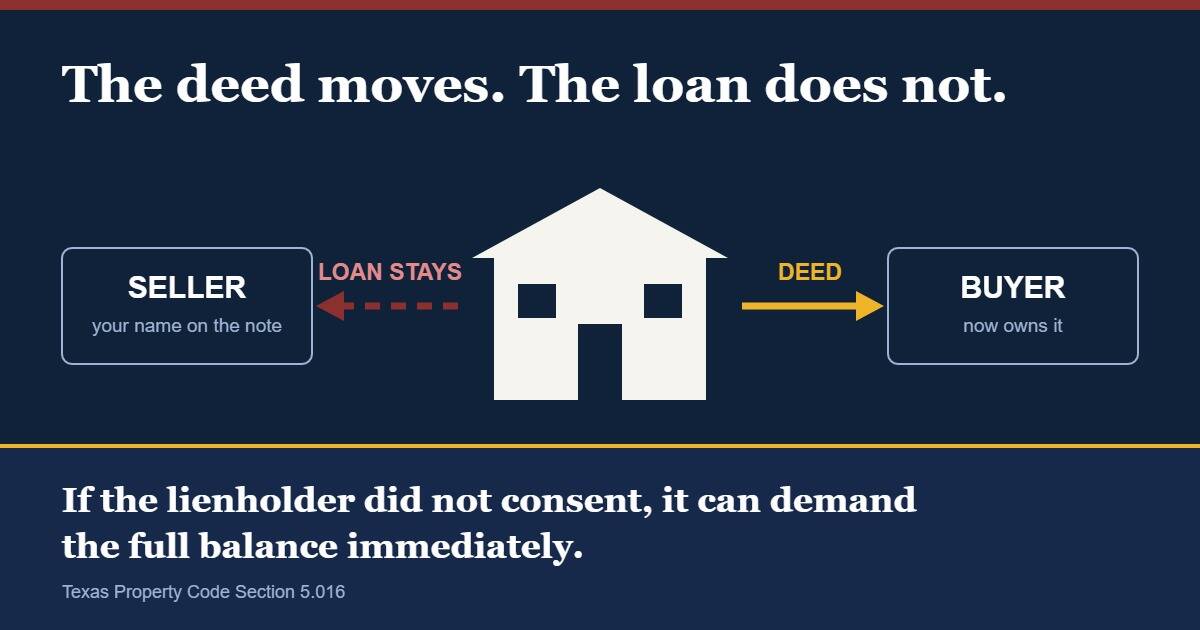
There is a kind of sale where the buyer does not pay off your mortgage. The deed moves to them, the loan stays in your name, and they make the payments. It gets pitched as a way out for somebody who is behind, and sometimes it genuinely is.
Texas has a statute written specifically for that situation, and in my experience almost nobody involved has read it. It is Property Code Section 5.016, it has been on the books since January 2008, and it puts a hard notice requirement on the seller seven days before anything gets signed.
What the statute actually prohibits
Section 5.016(a) is a prohibition rather than a suggestion. A person “may not convey an interest in or enter into a contract to convey an interest in residential real property that will be encumbered by a recorded lien at the time the interest is conveyed” unless a disclosure goes out first.
Note what triggers it. Not the loan being assumed. Not anybody’s intent. Simply that a recorded lien will still be on the property when the interest is conveyed.
And note who the notice goes to. The seller must provide it to “the purchaser and each lienholder.” Your lender gets a copy. That single requirement is the reason most of these deals would collapse if the statute were followed, and it is the clearest signal of what the legislature was worried about.
Seven days before the earlier of two dates
The timing is tighter than people assume. The disclosure has to be provided on or before the seventh day before the earlier of the effective date of the conveyance, or the execution of an executory contract binding the purchaser, an option contract, or other contract.
So the clock does not run from closing. It runs from whichever came first, the closing or the day you signed something binding. If you signed a contract on Monday, the notice was due the Monday before.
Seven things the disclosure has to contain
It has to be a separate written statement in at least 12-point type, and the statute enumerates what goes in it.
It identifies the property and gives the name, address and phone number of each lienholder. It states the amount of the debt secured by each lien. It specifies the terms of the contract or law under which that debt was incurred, including as applicable the rate of interest, the periodic installments required to be paid, and the account number. It indicates whether the lienholder has consented to the transfer to the purchaser. It specifies the details of any insurance policy relating to the property, including the name of the insurer and insured, the amount insured, and what property is insured. It states the amount of any property taxes due.
Read item four again. Whether the lienholder has consented. Not whether anybody asked. Whether they consented.

The warning the statute puts at the top in capitals
The seventh item is a statement that has to appear at the top of the disclosure, substantially in this form:
“WARNING: ONE OR MORE RECORDED LIENS HAVE BEEN FILED THAT MAKE A CLAIM AGAINST THIS PROPERTY AS LISTED BELOW. IF A LIEN IS NOT RELEASED AND THE PROPERTY IS CONVEYED WITHOUT THE CONSENT OF THE LIENHOLDER, IT IS POSSIBLE THE LIENHOLDER COULD DEMAND FULL PAYMENT OF THE OUTSTANDING BALANCE OF THE LIEN IMMEDIATELY. YOU MAY WISH TO CONTACT EACH LIENHOLDER FOR FURTHER INFORMATION AND DISCUSS THIS MATTER WITH AN ATTORNEY.”
The statute says it is possible, and I am going to leave it exactly there rather than tell you what your lender will or will not do. The point is that the legislature thought a seller should be looking at that sentence a week before signing, not afterwards.
What happens if the notice never goes out
Subsection (b) starts with something that surprises people. “A violation of this section does not invalidate a conveyance.” The deed still moved. You cannot unwind it on this ground alone.
What the purchaser gets instead is an exit. If a contract is entered into without the seller providing the notice, the purchaser “may terminate the contract for any reason on or before the seventh day after the date the purchaser receives the notice in addition to other remedies provided by this section or other law.”
For any reason, again, and the clock does not even start until the notice finally arrives.
The carve-outs, and the uncomfortable one
Subsection (c) lists transfers the section does not apply to. Most of the list is familiar from other parts of the code: foreclosure and court orders, trustees in bankruptcy, deeds in lieu, fiduciaries administering an estate or trust, co-owners, spouses and lineal relatives, divorce decrees, governmental entities.
Then two that are worth sitting with.
Item ten exempts a transfer “where the purchaser obtains a title insurance policy insuring the transfer of title to the real property.” An ordinary insured closing is outside the section entirely, which tells you the statute was never aimed at the normal transaction.
Item eleven exempts a transfer “to a person who has purchased, conveyed, or entered into contracts to purchase or convey an interest in real property four or more times in the preceding 12 months.”
Four or more times in a year. That is a professional. So the protection in this section switches off precisely when the buyer across the table does this for a living, which is a strange place to put the line and it is the line the statute draws. My own company clears that threshold comfortably, so this carve-out is one that benefits me, and I would rather say that than let you find it later.
Subsection (d) adds a safe harbor for the seller. A violation is not actionable if the person required to give notice “reasonably believes and takes any necessary action to ensure that each lien for which notice was not provided will be released on or before the 30th day after the date on which title to the property is transferred.” In other words, if the lien is actually getting paid off, the section is not trying to catch you.
What I would take from this if I were selling
If a buyer proposes leaving your loan in place, the fact that Section 5.016 exists at all should slow you down. The legislature wrote a bespoke disclosure, addressed it to your lender as well as your buyer, required a week of lead time, and put a capitalised warning at the top of it. Statutes do not get built that way for transactions that usually end well.
Ask the buyer directly whether the lien will be released at closing or left in place. Ask whether they have done four or more deals in the last twelve months, because the answer tells you whether this section protects you at all. And if the plan involves your name staying on a note after you no longer own the house, that is an hour with an attorney, not an hour on the internet.
Are you looking to Buy or Sell a Home in Denver?
Ready to sell your home quickly and at the right price? Find out how much your home is worth now!
If you’re looking for a new home in Denve CO we can help. Use these popular one-click searches to find what you’re looking for: