Inspection in homes that are built in a factory
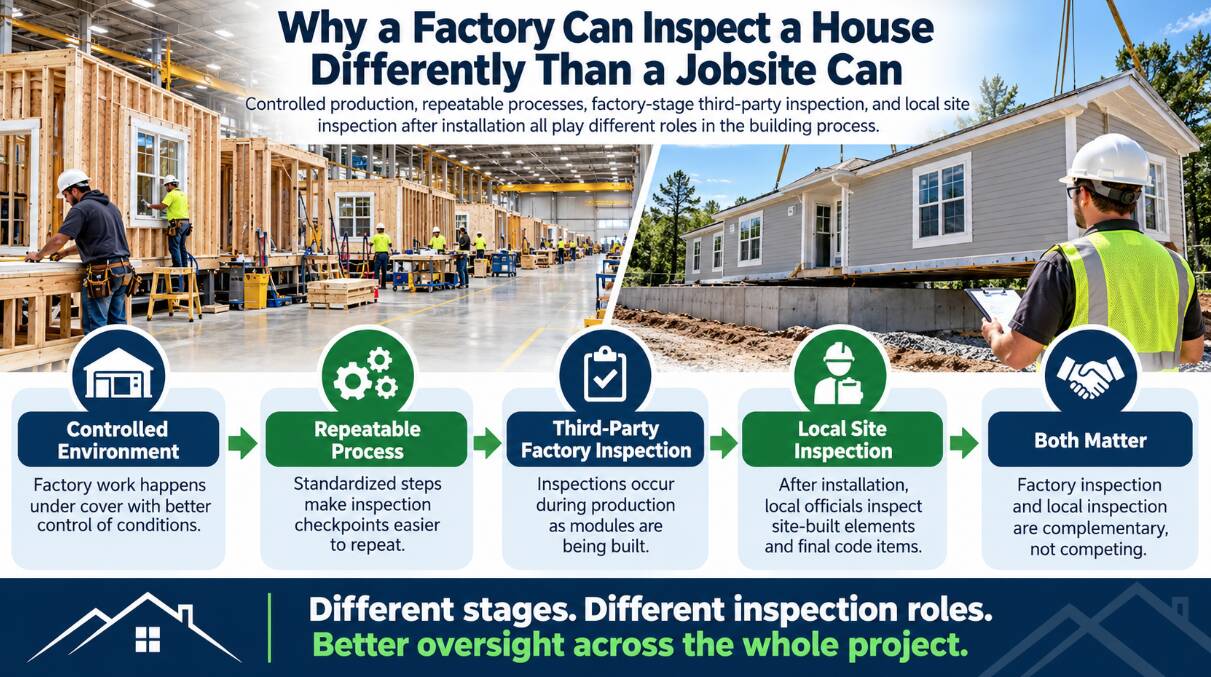
Most people hear the word inspection and picture the same thing: an inspector arrives at a jobsite, walks through the house, checks whatever stage of construction is visible that day, and either signs off or leaves a list of corrections. That is a familiar model. It is also only one way to inspect a house.
When a home is built using modular construction, a large portion of the work happens in a factory. That changes more than the location of the labor. It changes when work can be inspected, how accessible the assemblies are when they are inspected, how often the same process is repeated, and how quality control can be built into the production sequence itself.
That does not mean a factory makes mistakes impossible. It does not mean every modular home is automatically better than every site-built home. What it does mean is that the inspection environment is different, and that difference matters.
The Difference Is Access
Think about framing, electrical, plumbing, insulation and mechanical work on a conventional jobsite. The home is being assembled outdoors. Different trades arrive at different times. Some work is easy to see for a short period and then disappears behind insulation, drywall, siding or finishes. An inspector is trying to verify compliance at specific checkpoints while the construction schedule keeps moving.
Now compare that with a production environment where the house moves through defined stations. Framing is open. Mechanical systems are accessible. Walls are unfinished. The same types of assemblies appear again and again under good lighting and predictable working conditions. That gives both the factory quality team and independent inspectors a different opportunity to see the work before it is covered.
Modular Home Source explains that modular homes typically go through multiple factory-stage inspections, including a critical pre-drywall review, before they ever leave the plant. Its overview of inspections and quality control in modular is worth reading because it separates factory inspection from the local inspection that happens after the modules arrive on site.
Quality Control Is Not the Same Thing as Code Inspection
There is another distinction buyers and Realtors should understand. Factory quality control and code inspection are related, but they are not the same thing.
A manufacturer can have its own quality-control process that checks materials, dimensions, fasteners, wiring, plumbing, finishes and production tolerances as the home moves through the line. Separately, independent third-party inspectors may verify that construction complies with the approved plans and the applicable building code. Those are two different layers of oversight.
Impresa Modular describes this layered process in its article on the modular inspection process. Factory personnel conduct ongoing quality checks, third-party agencies verify code compliance, and the completed modules are still subject to local inspection once they are installed at the home site.
That last point is important. The factory does not replace the local building department.
The House Still Has to Pass Local Inspection
When the modules arrive, the site itself is still a conventional construction project. The foundation has to be correct. The modules have to be properly placed and connected. Utility connections have to be completed. Structural connections, plumbing, electrical systems, mechanical systems and final life-safety items still have to satisfy the requirements of the local jurisdiction.
In other words, the house is inspected in two worlds: first as a manufactured construction process inside the factory, then as a completed building on a specific piece of land.
That sequence is easier to understand when you look at how modular homes are built in the factory. The walls, wiring, plumbing, insulation, drywall and finishes are installed in a controlled sequence, with inspection points along the way. Once the modules are transported and set, the onsite portion of the project takes over.
Repeatable Processes Change What Inspectors Can Learn
There is another advantage to factory production that does not get talked about enough: repetition.
On a traditional custom jobsite, an inspector may see a different builder, different subcontractors, different details and different site conditions from one house to the next. In a factory, many of the same crews perform the same types of tasks at the same stations repeatedly. That creates the opportunity to identify recurring defects, improve procedures, retrain workers and change a production detail before the same problem is repeated across future homes.
That is one of the fundamental differences between construction and manufacturing. Manufacturing can turn quality into a process instead of relying only on final inspection.
Impresa’s Building Beyond Code discussion makes the same broader point. Modular construction concentrates production in a controlled setting, where plans can be reviewed, work can be documented and inspections can occur before modules leave the factory. The home still has to meet the applicable building code for the location where it will ultimately be installed.
Inspection Is Easier Before the Wall Is Closed
If you have ever remodeled a house, you already understand this intuitively. It is a lot easier to evaluate plumbing when the pipe is exposed. It is easier to inspect wiring when the wall is open. It is easier to check framing connections when insulation and drywall have not covered them.
The factory simply creates more opportunities to inspect work while it is still accessible. That does not guarantee perfection. What it does is improve the odds that a problem is caught when the correction is still simple.
The production sequence described in Impresa’s quality-control overview is built around that idea: inspect materials and assemblies during production rather than waiting until the entire house is complete and hoping the finished surfaces tell the whole story.
The Factory Does Not Eliminate Human Error
This is where I think our industry sometimes oversells the factory advantage.
Factories have people. People make mistakes. Components can arrive defective. A measurement can be wrong. A fastener can be missed. A connection can fail. Transportation and set can introduce issues. Onsite completion can create its own problems.
So the argument should not be that factory construction eliminates defects. It does not.
The better argument is that a controlled production environment gives us more opportunities to prevent, identify and correct defects before they become hidden, expensive or difficult to repair.
Why Realtors Should Understand This
Most buyers do not need a lecture on third-party inspection agencies or factory quality manuals. They need a simple explanation when they ask, ‘How do I know the house is being built correctly if I cannot drive by the jobsite every day?’
The answer is that modular construction changes where the work is observed, not whether it is inspected.
The modules are built through a controlled sequence, factory quality checks happen during production, independent inspections verify key stages, and the completed home still goes through the local inspection process after installation. Impresa’s step-by-step modular building process helps put those stages into context for buyers who are unfamiliar with offsite construction.
For a Realtor, that is enough knowledge to answer the first question intelligently and then bring the builder or inspector into the conversation for the technical details.
The Bigger Point
For more than 25 years, I have watched our industry talk about factory construction as if the biggest advantage were simply that the house is built indoors. That matters, but I think it misses the bigger manufacturing lesson.
The real opportunity is control.
Control the sequence. Control material exposure. Control the handoffs. Create repeatable work. Inspect while assemblies are accessible. Document what happened. Correct problems before the next stage begins.
That is how manufacturing improves quality. It is not magic. It is process.
And when we talk about the future of homebuilding, that distinction matters a lot more than whether the walls happened to be framed inside a building or outside on a lot.
Are you looking to Buy or Sell a Home in Denver?
Ready to sell your home quickly and at the right price? Find out how much your home is worth now!
If you’re looking for a new home in Denve CO we can help. Use these popular one-click searches to find what you’re looking for: